


Summary
Garage break-ins usually start with an exposed emergency release cord, a knob-locked service door, or a remote left in a parked car. A top-panel shield, a deadbolt, and a keychain fob close those gaps, and most hardware upgrades cost $60 or less. Rolling-code smart openers, motion lights, sensors, and cameras add a second layer, while solar and battery models protect detached structures without electricity.
Common Garage Door Break-In Methods Thieves Rely On
Learning how to secure garage door access starts with knowing how thieves get in. FBI crime data shows most residential burglaries involve forced entry, and an attached garage is a common starting point because it connects directly into the house.
Why the Fishing Method Defeats Most Overhead Doors
Every automatic opener has an emergency release cord so you can lift the door by hand during a power outage. A thief slides a coat hanger through the gap above the top panel, hooks the cord, and pulls. On an unprotected door it takes about six seconds.
Worn weatherstripping widens that gap. Pressing down on the top section opens more room to work.
Side Doors, Windows, and Other Overlooked Entry Points
Most garages have a service door fitted with a knob lock and no deadbolt. A pry bar or a shoulder gets through it in seconds.
Clear garage windows show anyone walking past what's inside: bikes, tools, a generator, or a second car.
Stolen Remotes and Intercepted Garage Door Signals
A remote clipped to your visor turns a car break-in into house access. Thieves check vehicles parked in driveways for this reason.
Openers made before the late 1990s used fixed codes that a scanner could capture and replay. If your door hesitates, opens on its own, or only responds at close range, have the opener checked.
Good Habits That Keep Your Garage Door Secure Daily
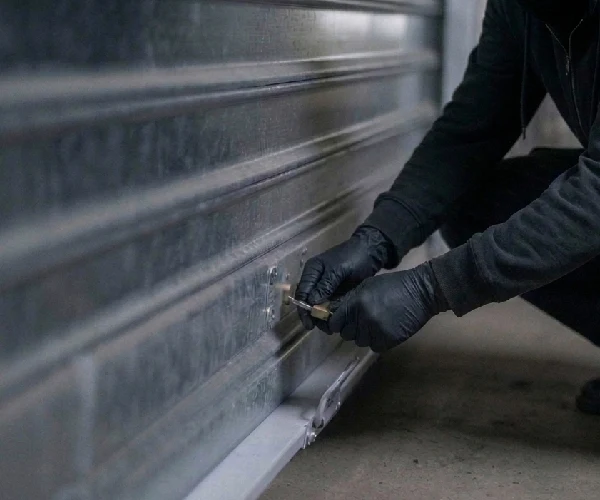
Close the door every time, including short trips. Engage the manual track lock on older garages whenever the space isn't in use, and put a deadbolt on the door between the garage and the house.
Keep the remote inside or on your keychain rather than in the car.
Check the gears, rails, and rollers once a season for rust and damage; a worn door is easier to force, so this is a garage door safety issue as much as a cosmetic one. Springs, chains, and straps should be replaced by a professional before they fail.
Low-Cost Solutions to Prevent Garage Door Break-Ins
Regular garage maintenance handles wear. These parts handle the common attacks, and most install in under an hour.
| Upgrade | Typical Cost | Install Time | What It Stops |
|---|---|---|---|
| Zip tie on the emergency release | Under $5 | 5 minutes | Coat hanger fishing |
| Garage door shield | $20 to $40 | 15 minutes | Fishing and prying at the top panel |
| Sliding bar or track lock | $15 to $30 | 20 minutes | Lifting the door off its track |
| Floor threshold lock | $25 to $50 | 45 minutes | Forced lifting from outside |
| Frosted window film | $10 to $25 | 30 minutes | Scouting what's inside |
| Deadbolt on the service door | $30 to $60 | 45 minutes | Kick-ins and pry attacks |
Quick Tip
A garage door shield stops the six-second coat hanger trick from outside. Unlike a zip tie, it leaves the emergency release free to work in a power outage.
How to Zip-Tie the Emergency Release in Five Steps
Use a standard nylon zip tie, not a heavy-duty or metal one. The tie has to snap under a firm pull from inside so the release still works when you need it.
That matters because the emergency release is a safety device. It's how you open the door by hand in a power outage and how anyone inside gets out if the opener fails. Never use a tie strong enough to hold under a hard pull.
Skip this fix if the garage is the only exit from part of your home, or if a child, an older adult, or anyone with limited strength might need to use the release alone. A garage door shield is the better option in those cases, since it blocks outside access without restraining the cord itself.
- Close the door fully and unplug the opener.
- Locate the red release handle and the trolley it connects to on the rail.
- Thread the zip tie through the release lever and the trolley hole, then pull it snug.
- Trim the tail, plug the opener back in, and confirm the door still cycles normally.
- Pull the release handle firmly to check that the tie breaks, then fit a fresh one.
A garage door shield covers the release bar with a metal plate and leaves the cord free to work. Removing the release entirely also stops the attack, but you'll need an exterior key release for power outages.
Installing a Floor Threshold Lock for Extra Reinforcement
A threshold lock anchors the bottom of the door into the concrete, so the panel can't be lifted even if the opener is defeated. Mark the spot along the inside edge, drill with a masonry bit, then set the sleeve and bolt.
Place it near the center of the door. Single-car doors need one; wide double doors need two.
Securing a Garage Door From the Outside and On Vacation
Most modern openers include a vacation or lockout mode that disables every remote until you switch it back on. Use it before you leave, then unplug the opener as a backup.
To freeze the door in place, run a padlock through a hole in the track just above a roller. The door can't travel even if someone reaches the release.
Put interior lights on timers, hold off on travel posts until you're home, and have a neighbor collect packages.
Hi-Tech Security Devices That Guard Your Garage Door
Smartphone Apps and Smart Garage Door Opener Systems
A wireless smart garage door opener reports the door's status, closes it remotely, and sends a notification whenever it moves. Most tie into wider home security platforms.
Look for rolling-code technology, which changes the signal after every use and makes interception useless.
Keychain Openers That Keep Your Remote Out of the Car
Keychain openers give you access without leaving hardware in a parked vehicle. They pair with most units made in the last twenty years and carry three or four buttons.
Exterior wireless keypads work alongside them. Change the code a few times a year.
Motion-Sensor Lights That Expose Anyone in Your Driveway
Studies of residential lighting programs have measured drops in nighttime property crime once entries and driveways stay lit. Most motion sensor lights use two bulbs set at a 90-degree angle to cover a full driveway.
Choose a waterproof model in wet climates and a solar unit where running power is difficult.
Garage Door Alarms and Security Sensors Worth Adding
Contact sensors on the door, tilt sensors on the panel, and glass-break sensors at the windows trigger the moment something opens or shatters. Many security systems wire every window in the house and skip the garage, so check your coverage.
AI Cameras and the Future of Garage Door Surveillance
Newer cameras classify what they record, separating a delivery driver from someone loitering at the side door and cutting false alerts. License plate recognition and package detection are moving into consumer models.
Pair any camera with local storage so a cut internet line doesn't erase the footage.
Detached Garage Security Without Power or Wired Alarms
A detached garage is farther from the house, so fewer people hear a forced entry. It also tends to hold mowers, power tools, bikes, and ladders that help someone reach an upper-story window.
Start with hardware, since there's usually no opener to protect: a hardened padlock, a heavy hasp, and a solid-core service door with a deadbolt.
No electricity isn't a barrier. Solar motion lights, battery-powered door alarms, and cellular cameras with rechargeable packs all run independently, and a wireless chime can relay alerts to the house. Anchor valuables to the floor with a ground anchor and chain, and store ladders inside.
Final Thoughts on Making Your Garage Door More Secure
Work through the fixes in order of payoff: shield the emergency release, deadbolt the service door, frost the windows, move the remote out of your car, and inspect the hardware each season. Add a smart opener, motion lighting, sensors, or a camera once the mechanical basics are covered.
Feldco has served over 500,000 homeowners across Illinois, Wisconsin, Indiana, and Iowa, and has been the Midwest's number one home exterior company since 1976. That includes garage doors built to seal tight and hold up against forced entry. Speak with a product specialist and get a free quote today.
FAQs
Are smart garage door openers more secure than a manual lock?
They cover different risks. A rolling-code smart opener blocks signal interception and alerts you when the door moves, while a manual lock physically prevents the door from opening. Using both gives you the strongest setup.
How can I tell if my garage door remote signal is being jammed or intercepted?
Watch for a door that won't respond at normal range, opens without input, or works only from a few feet away. Replace the batteries first, then have a technician confirm the opener isn't running an outdated fixed code.
How do I lock my garage door from the inside during a power outage?
Pull the emergency release to disconnect the trolley, lower the door by hand, then engage the manual slide lock or run a padlock through a hole in the track. Both hold the door shut until power returns.
Can I secure a detached garage that has no electricity?
Yes. Solar motion lights, battery-operated door alarms, and cellular cameras with rechargeable batteries need no wiring, and a hardened padlock with a heavy hasp secures the door itself.
How often should I inspect my garage door's security hardware?
Check the rollers, tracks, cables, and release shield once a season, which works out to four inspections a year. Call a professional immediately if you find frayed cables or a stretched spring.


 866-4FELDCO