


Summary
Your garage door can cover close to a third of the front-facing exterior of your house, and your entry door sits right beside it as the focal point. This guide walks through how to coordinate style, material, color, glass, and hardware between the two doors. It also covers when a complementary pairing beats an exact match.

Know Your Home's Architectural Style Before You Shop
Before you compare swatches or panel designs, name the style of your house. A matching front door and garage door only works when both answer to the same architecture. Get that part wrong and no amount of color coordination will fix it.
Having a common home style doesn't mean you're stuck with the same entryway as every neighbor on the block. There's real range inside any style.
Traditional styles like colonial and craftsman pair well with rustic doors. These entryways don't need glass, though a glass feature usually looks best. Small windows along the top of the garage door echo that detail without competing with it.
Modern architecture handles bolder shapes. Think multiple panes in unusual proportions, flush panels, and long horizontal window bands running across the garage.
Older homes inspired by European design often call for a rounded entry door. A rounded garage door isn't realistic, so accent the opening with rounded molding above it instead.
Accents around the entry door matter too. A pair of sidelights, combined with a glass pane in the door itself, brightens the whole entrance.
Symmetrical homes, such as a Greco-Roman style, can double up on both doors for a balanced, formal look. More pastoral homes can go off the beaten path with a dutch entry door.
Complementary Designs and Materials That Tie Doors Together
The entryway is the focal point, and the garage should support it. You want a garage door that looks good without pulling attention away from the front door.
An exact copy isn't the goal. Look at your preferred entry door abstractly. What shapes does it use? How does it sit against the surrounding architecture? Does it read simple or busy? Those answers point you toward a garage door that complements it.
A rounded entry door pairs with a rounded glass pane on the garage. If the entry leans on rectangles, square panels across the garage work well. The two doors should look like sisters, not twins.
Ornate entry details, like a fleur-de-lis or floral ironwork, need a quieter garage door to balance them. Restraint on one side buys you drama on the other.
Material is the one element worth matching outright. Both doors come in the same three families:
- Wood: the most customizable option and the best looking to many eyes, though it costs more and needs regular upkeep.
- Steel: durable, low maintenance, and easy to finish in any color. It suits modern and mid-century exteriors.
- Fiberglass: it mimics wood grain, resists dents and rot, and holds up through Midwest freeze-thaw cycles.
Match the material to the house as well as to the other door. Modern homes wear steel well, while a colonial looks right in wood or a wood-grain fiberglass.
Quick Tip
Choose your entry door first, then pick a garage door that shares its style and material without copying its design.
Windows and Glass That Carry the Same Look Across Doors
Glass is where a lot of otherwise good pairings fall apart. Seeded glass on the garage next to frosted glass on the entry reads as an accident rather than a decision.
Pick one glass treatment and use it on both doors. Shape and grille pattern should also echo the windows already on your house. A row of arched lights on the garage calls for an arched light in the entry door.
Glass does practical work too, pulling daylight into the garage and the foyer. Choose obscured or frosted panes when privacy matters more than the view.
Black frames remain a strong look on both doors. Add black inserts to the glass on each one, or go further and finish both doors in black to pick up the trim on your windows.
Hardware and Accents That Pull the Whole Look Together
Hardware covers handles, hinges, knockers, step plates, bolts, and latches. These pieces are small, and they're the ones visitors see up close.
Choose one finish and carry it across both doors. Matte black on the entry handle and copper on the garage pulls the eye in two directions and undoes the work you put into style and color.
Check the rest of your exterior metal before you commit. Light fixtures, house numbers, railings, and gutters all read as part of the same palette from the street.
Keep the count low. One or two decorative elements per door finish the look, while four or five turn it into clutter.
Color Theory for Your Front Door and Garage Door Combo
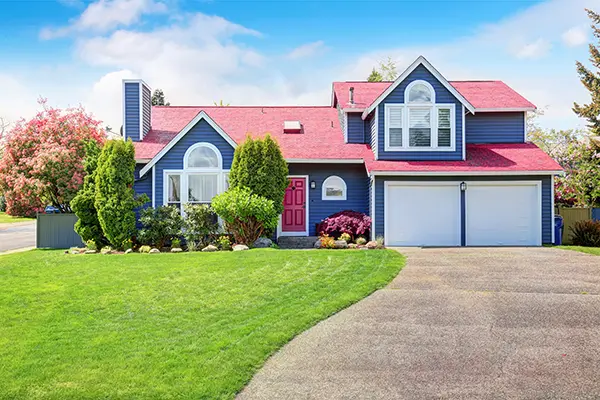
Color registers before shape or material does. Skip whatever is trending this season, because trendy today usually reads as dated in five years.
Stick to three colors across the exterior: one for the walls, one for the trim, and one for accents like shutters, window frames, and doors. Anything past that gets busy fast.
Bright shades expand and highlight, so they draw the eye straight to the entry. Dark shades do the opposite and add weight and formality. Both work, and the question is simply which part of the facade you want people to notice first.
Keep warm tones with warm tones and cool with cool. Mixing the two lanes is the most common clash homeowners run into.
Complementary colors sit opposite each other on the wheel, like orange and blue, and they rarely appear together on houses. Analogous colors sit side by side, like red next to orange and purple, and they blend easily. Neutrals give you more freedom than either: a red door against gray and black siding pops without fighting anything.
Painting the garage door color the same as the house body is the safest move you can make. It lets the garage recede so the entry takes center stage. Matching the garage to the trim works too, though the result can look flat. Order physical samples and check them in morning and evening light before you commit.
Matching Doors vs. Complementary Colors: Pros and Cons
Homeowners who want garage and front doors that match land in one of two camps. Either both doors wear the same color, or the garage stays neutral while the entry carries a bolder shade. Both approaches hold up.
| Approach | Pros | Cons |
|---|---|---|
| Same color on both doors | Reads as deliberate and unified; simple to specify; forgiving on symmetrical facades | Can look monolithic; the entry loses its focal point; a dark match makes the garage dominate |
| Neutral garage, bold entry | Sends the eye to the front door; adds personality without repainting the house; easier to change later | Needs a careful undertone match; a poor pairing looks unplanned; two decisions instead of one |
Most designers lean toward the second approach, keeping the garage white or neutral and saving the statement color for the entry. If handcrafted stone or striking siding is the feature you want noticed, understate both doors instead.
The Curb Appeal Value of Matching Front and Garage Doors
Garage door replacement has ranked at or near the top of the annual Cost vs. Value Report for years, and steel entry door replacement sits close behind it. Few exterior projects return as much of what you spend.
Doing both at once compounds the effect. Two new doors that ignore each other still look like two separate projects, while a front door and matching garage door read as one finished exterior.
Buyers treat a coordinated facade as evidence the house has been cared for. That impression forms in the seconds between the curb and the front step, long before anyone sees the kitchen.
Make Your Entry and Garage Doors Pop Without Clashing
Work through the decision in order instead of picking a favorite door and hoping the rest falls into line:
- Identify your home's architectural style and rule out anything that fights it.
- Choose the entry door first, since it carries the focal point.
- Pick a garage door that echoes its shapes without copying them.
- Match the material across both doors, then align the glass and the hardware finish.
- Settle the color last, working within three colors for the whole exterior.
A heavy wooden slab looks wrong on ultra-modern architecture, and a flat steel garage door looks wrong on a Victorian. Get the style right and every smaller choice gets easier. Treat the rest as guidelines and bend them where your house calls for it.
Get Matching Front and Garage Doors Installed by Feldco
Feldco has replaced more than 100,000 doors and served over 500,000 homeowners across Illinois, Wisconsin, Indiana, and Iowa. Our entry doors are built for Midwest weather and finished in colors that hold up to sun, snow, and repeated freeze-thaw cycles.
Talk with a product specialist about pairing your entry door with your garage door, then get a free quote on the work.
Front Door and Garage Door Matching Questions, Answered
Should your front door and garage door match exactly?
No, and they shouldn't. Share the style, material, glass treatment, and hardware finish between them, then let the color differ if you want the entry to stand out.
Can the garage door be the same color as the house?
Yes, and it's one of the safest choices available to you. Painting the garage door to match the siding lets it recede so the entry door becomes the focal point.
Which garage door and front door color combinations work best?
A neutral garage door with a saturated entry door is the most reliable front door garage door combo. Navy, black, deep red, and forest green all read well against white, gray, or taupe.
How do you pick an entry door to go with a garage door you already have?
Start with the existing garage door's panel shape, glass style, and hardware finish. Then choose an entry door that repeats one or two of those elements rather than all of them.
Does replacing both doors add much curb appeal value?
Yes. Garage doors and entry doors both rank among the highest-return exterior projects year after year, and replacing them together makes the front of the house read as one deliberate design.


 866-4FELDCO