


Summary
A failed spring is the most common reason a garage door stops opening, and a two-minute balance test confirms it. Watch for uneven travel, grinding noises, and a door that won't hold halfway up. Professional replacement of a pair costs about $150 to $350, and the stored tension makes it a job for a trained technician.
What a Garage Door Spring Does and Why It Eventually Fails
A residential garage door weighs between 150 and 400 pounds. The spring above the opening carries nearly all of that weight, so the opener only guides the door along its track. Anyone researching how to replace garage door springs is dealing with the hardest-working part of the system.
Springs store energy through tension. As the cables wind onto the drums, that stored energy pulls the door upward. Once a spring loses tension or snaps, the motor has to lift the full weight on its own, and it can't.
Most springs carry a 10,000 cycle rating. One cycle equals one open and one close, so four trips a day uses up that rating in about seven years.
Torsion Springs Versus Extension Springs: Key Differences
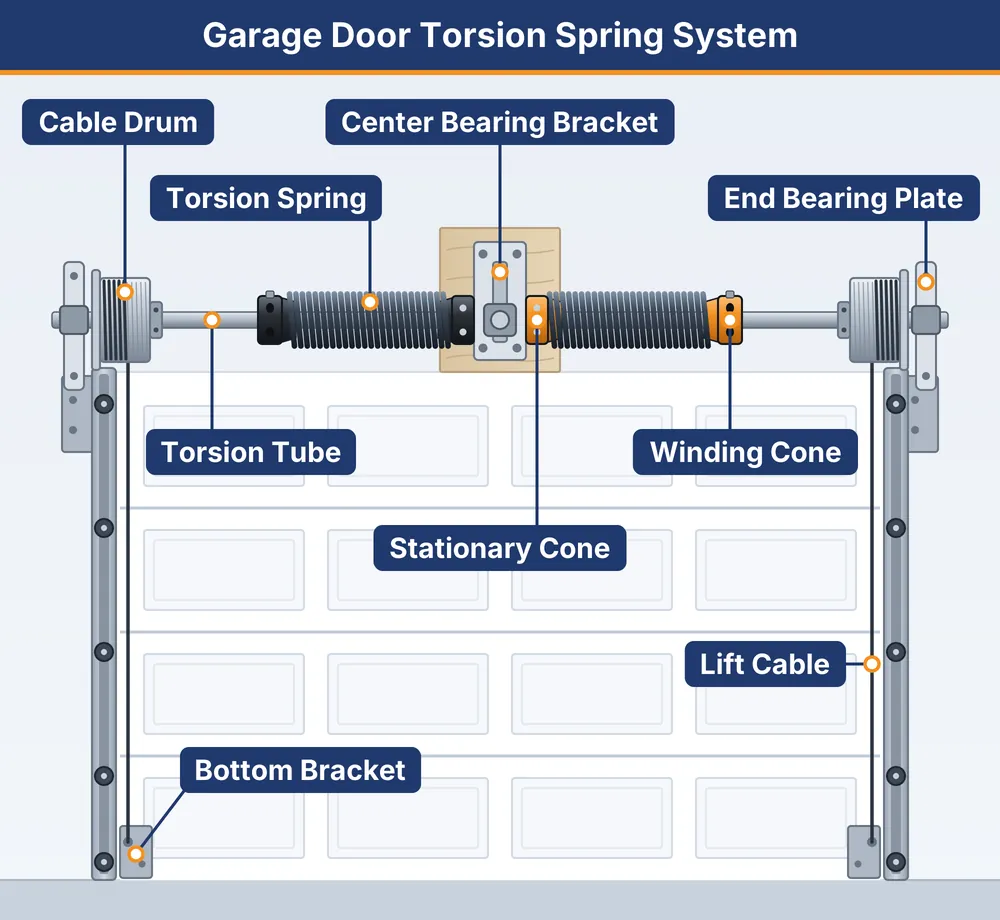
Torsion springs sit on a steel shaft above the door opening and wind tightly to store energy. They appear on most modern doors, and garage door torsion spring replacement calls for winding bars and an exact turn count.
Extension springs stretch along the horizontal tracks on both sides of the door. They cost less up front, but without a safety cable through the coil, a snapped one throws metal across the garage.
Oil-Tempered and Galvanized Springs: How Their Lives Differ
Oil-tempered springs are heat treated and coated during manufacturing. They hold their rated cycle life well and run quietly, though the coating drips and the surface rusts in damp garages.
Galvanized springs carry a zinc coating that resists corrosion, but they squeak more and give up some cycle life. Neither type is stronger; they simply age differently.
Signs of a Faulty Garage Door Spring You Should Never Ignore
Watch the door run for a few minutes before you assume the worst. A coil can wear out badly without showing a clean break. Here are the signs your garage door spring is broken or close to it.
Issues With Balance and Uneven Movement Along the Track
An unbalanced door fights you on the way up and drifts on the way down. It may drop suddenly after rising a few inches, crawl more slowly than it used to, or clunk loudly during travel. Keep running a door that pulls to one side and the strain lands on the spring until something gives.
Excessive Screeching, Grinding, and Other Warning Noises
Noise ranks as the most common complaint homeowners bring to a garage door company. Springs are bare metal parts that need oil, and skipping that job shortens their life. Lubricate once a year, or every six months if a component already squeaks, timing the passes for after the last freeze and again in fall.
The Door Does Not Remain Open When You Lift It Halfway
Springs do close to 90% of the lifting every time the door moves. A door that slides back down instead of holding position has a tension problem. One that rises a few inches and stops usually has a snapped spring rather than a loose one.
Deterioration of Cables, Rollers, and Mounting Hardware
Close the door, step inside, and inspect the hardware. Look for fraying on the cables, flat spots on the rollers, rust on the brackets, and grooves in the pulleys. Worn parts load extra work onto the springs, so even healthy ones fail early.
First Steps To Take the Moment a Garage Door Spring Breaks
A snapping spring produces a bang loud enough that people think something exploded in the garage. Stop using the door the moment you hear it.
- Leave the door closed and unplug the opener so nobody presses the button.
- Look above the door for a visible gap in the coil, the clearest confirmation of a break.
- Clamp vise grips onto the track below a roller if the door is stuck open.
- Book a repair the same day instead of forcing the door with the motor.
Quick Tip
Unplug the opener the moment a spring snaps. Running the motor against a broken spring bends the top section of steel doors and strips the plastic gears inside.
Troubleshooting Your Garage Door Spring With a Balance Test
The balance test tells you in two minutes whether the counterbalance system still works. Run it any time the door feels heavy, sounds rough, or moves unevenly.
- Confirm the door is fully closed. Never disconnect anything while it sits partway open.
- Pull the red emergency release cord straight down to detach the door from the motor.
- Lift the door by hand to waist height. If it feels heavy, hold on and lower it slowly rather than letting go.
- Release your grip. A balanced door holds that position without creeping up or drifting down.
- Raise the door to shoulder height and repeat. It should hold there too.
Movement in either direction points to a spring that has lost tension or broken. A small force adjustment on the opener covers a marginal case, and your owner's manual lists the correct setting.
Tools and Materials Required for Garage Door Spring Work
This list covers what a garage spring replacement actually takes.
- Two winding bars, 1/2 inch by 18 inches, with square-cut ends that seat fully in the cone
- Two 10 inch vise grips to lock the shaft and the vertical track
- An adjustable wrench or socket set for the set screws and drum hardware
- A sturdy step ladder, safety glasses, and gloves
- A tape measure, a ruler, and a file for smoothing the shaft
- Matched replacement springs, plus safety cables on extension systems
A screwdriver is not a winding bar. That substitution sends the coil spinning out of control and causes more emergency room visits than any other error on this job.
Choosing the Right Replacement Spring for Your Door
An oversized spring rockets the door off its track. An undersized one lets it slam down. The specification matters more than the brand.
Measuring Length, Diameter, and Wire Size Without Guessing
Lay the old spring flat and measure the coil length, excluding the cones. Measure the inside diameter across the opening, commonly 1 3/4, 2, 2 1/4, or 2 5/8 inches. Then measure 20 coils and divide by 20 for the wire size.
Weighing Your Door To Match the Correct Spring Size
Roughly one door in ten leaves the factory wrongly sprung, so copying the old part can repeat someone else's error. Disconnect the opener, close the door, set an analog scale under the center of the bottom section, and lift until the door breaks free.
Telling Left-Wind and Right-Wind Torsion Springs Apart
Stand the spring upright with the end facing you. A right-wind coil points its wire end to the right and usually carries a red cone; a left-wind coil points left and carries a black one. Right-wind mounts to the left of the center bracket, and left-wind mounts to the right.
How To Replace Garage Door Springs From Start To Finish
Here is what a technician does on a standard torsion setup. Read it to gauge the scope of the work, not as permission to attempt it.
- Close the door, unplug the opener, and disengage the trolley.
- Mark the cable drums and the torsion shaft so the door can be leveled later.
- Unwind the old springs with winding bars, a quarter turn at a time.
- Loosen the center bracket bolts and the drum set screws.
- Slide the old springs off the shaft and inspect the bearings.
- Slide the new springs on, checking the wind direction on each side.
- Reinstall the drums, seat the cables, and secure the stationary cones.
- Wind each spring to its rated turn count, typically 7 1/2 turns on a 7 foot door.
- Test the balance, lubricate the coils, and reconnect the opener.
Releasing Tension on a Torsion Spring Without Losing Control
Insert a winding bar fully into a cone hole and listen for the click that confirms it seated. Grip the far end, then loosen the set screws. Keep a bar in the cone until the spring runs slack, and stand beside it rather than under it.
Adjusting Garage Door Springs and Balancing the New Setup
A correctly sprung door stays on the floor when closed, holds at the halfway point, and stays up when fully open. If it sinks from halfway, add a quarter turn of tension to each spring; if it pulls itself upward, remove a quarter turn. A door that still misbehaves needs different springs, not more adjustment.
What Causes a Garage Door Spring To Break Before Its Time
Age accounts for most failures, but four other factors show up again and again on service calls.
- Rust, which adds friction between coils and eats into the wire
- Cold snaps, which stiffen steel and concentrate stress at weak points
- Undersized springs installed by a previous contractor
- Skipped lubrication over several years of daily cycles
Doors used as a home's main entrance cycle far more than four times a day. In those garages, high-cycle springs rated for 20,000 openings pay for themselves.
Spring Inspection and Maintenance That Prevents Failure
A monthly spring inspection takes less time than moving the trash cans. Close the door, look for gaps in the coil, check the cables for fraying, and listen for new noises on the next cycle.
Twice a year, spray a garage door lubricant across the coils, hinges, rollers, and bearings, then wipe the excess. Skip the WD-40, which strips lubricant instead of adding it. Check garage door spring tension with the balance test at the same time.
When To Call a Technician Instead of Replacing Springs Yourself
Professional garage door spring replacement runs roughly $150 to $350 for a pair, including labor and parts. Extension springs land at the lower end, heavy insulated doors at the upper end, and after-hours calls add to the total.
Set that against the risk. Stored energy releases in a fraction of a second, and recorded outcomes include broken bones, lost fingers, and deaths. Call a technician right away if you see a gap in the coil, if the cables have jumped their drums, or if the door hangs crooked.
Feldco has served more than 500,000 homeowners across Illinois, Wisconsin, Indiana, and Iowa since 1976, replacing over 100,000 doors along the way. Every product is built for Midwest weather and installed by a factory-trained crew. Talk with a product specialist and get a free quote on your project today.
FAQs
Can you fix a garage door spring by yourself?
You can, but the tension stored in a wound spring makes this one of the most dangerous repairs in a home. Without winding bars and an exact turn count, the odds of injury are high enough that technicians advise against it.
How much should it cost to fix a spring on a garage door?
Expect $150 to $350 for a professional replacement of a pair, depending on spring type, door weight, and local labor rates. Emergency and weekend service adds to that figure.
How do you open a garage door with a broken spring?
Pull the emergency release cord, then lift with a helper on each side, because the full weight of the door is on you. Prop it with vise grips clamped to the track before walking away.
Can I replace only one garage door spring if the other is fine?
Replace both. The second spring has logged the same number of cycles and will fail soon after, and mismatched tension pulls the door out of balance in the meantime.
What is the lifespan of a standard 10,000 cycle garage door spring?
About seven years at four openings per day. Doors that see ten or more cycles daily can wear out the same spring in three to four years.


 866-4FELDCO