


Summary
Garage door openers built before the mid-1990s send the same radio code on every press, and a cheap handheld receiver can capture it in seconds. This guide covers how thieves intercept opener signals, how to spot a compromised opener, and which upgrades shut the attack down.
Why Garage Door Openers Are an Easy Target for Burglars
Garage doors are among the most commonly targeted entry points on a house. They're simpler to defeat than a front door, and most homeowners spend far less securing them. Once a thief is inside an attached garage, the rest of your home is one unlocked door away.
Learning how to prevent garage door hacking matters because the weak link isn't the door. It's the opener. Police departments have warned for years that garage door openers can be hacked using hardware anyone can buy online.
How Thieves Break Into Your Garage Door Opener Signal
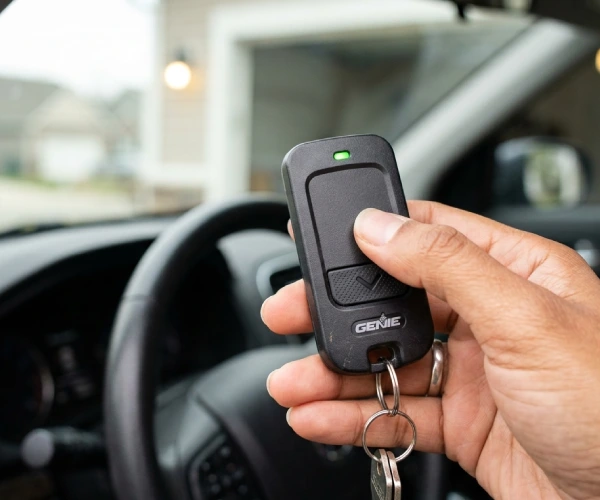
Your remote talks to the opener over low-frequency radio, usually between 300 and 400 MHz. On older units that signal isn't encrypted, so anyone with a receiver parked nearby can listen in.
The oldest of the garage door hacks is the code grabber. A thief leaves the device near your driveway, waits for you to press the remote, and records the transmission. On a fixed-code opener, that one recording works forever.
Rolling-code openers block that trick, but jamming hardware gets around it. The device blocks your first press, stores that code, and lets the second through so the door opens normally. The burglar keeps the unused code and returns later, and hacking tools to open garage doors this way cost under $100.
Fixed Code vs Rolling Code Opener Security Compared
Rolling code technology defeats replay attacks by making every code disposable. Each press pulls a fresh code from a synchronized algorithm, and a recorded code dies the moment it's used.
| Security detail | Fixed code opener | Rolling code opener |
|---|---|---|
| Code behavior | Identical code every press | New code every press |
| Typical era | 1970s to early 1990s | Mid-1990s to today |
| How to identify it | Dip switches inside the remote | Circuit board, plus a "Security+" or "Security 2.0" label |
| Beaten by a code grabber | Yes, on the first recording | No |
| Beaten by signal jamming | Yes | Yes, with the right hardware |
Pop the back cover off your remote. Dip switches mean you're running fixed code, and that opener belongs in the recycling bin.
Signs Your Garage Door Opener Has Been Tampered With
A compromised opener almost never looks broken. Watch for these warning signs:
- Your garage door randomly opened or closed while nobody was home.
- Someone opened your garage door and took nothing, which often means a test run.
- The door responds slowly, or needs two presses when one always worked.
- A garage door opener was stolen from your car and never reprogrammed out.
- An unfamiliar box or antenna sits hidden near the door frame or driveway.
Reprogram the unit if any of these sound familiar. Erase every stored code first, then re-pair only the remotes and keypads you still hold.
Simple Ways to Stop Your Garage Door From Being Hacked
Preventing garage door break ins starts with habits that cost nothing:
- Take the remote out of your car. A smashed window shouldn't hand someone your house.
- Never leave the door open while you're out back or down the street.
- Lock the interior door between the garage and your house every night.
- Add a deadlock to the door track and throw it whenever you travel.
- Install motion-sensor lights over the driveway and beside the garage.
- Switch the opener to vacation mode, or pull the red release cord, before trips.
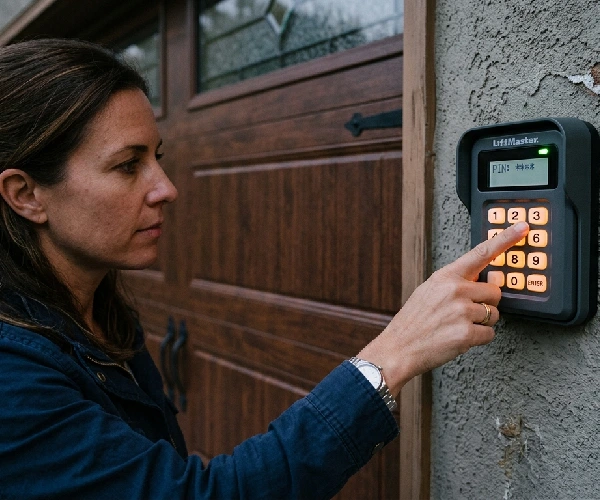
- Change your garage door keypad code twice a year, skipping birthdays and addresses.
Securing a Smart Garage Door Opener on Your Network
A Wi-Fi opener buys you convenience and a second way in. Anyone who reaches your home network can reach the opener on it.
- Turn on two-factor authentication inside the opener's app.
- Replace your router's default admin password and rename the network.
- Move the opener and other smart devices onto a separate guest network.
- Install firmware updates as they arrive, since manufacturers patch known flaws.
- Enable push notifications so every open and close reaches your phone.
Stronger Garage Upgrades That Deter Break-Ins Long Term
These cost more, and they stop the thieves who skip radio signals entirely:
- Replace the interior door with a solid, heavy-gauge door and anti-kick hardware.
- Mount cameras covering the driveway and the inside of the garage.
- Add a monitored motion detector that alarms and alerts you when you're away.
- Upgrade to an insulated steel garage door, since thin panels can be pried or kicked.
Get a Stronger, More Secure Garage Door From Feldco
The best opener on the market still needs a solid door behind it. Feldco has been the Midwest's #1 home exterior company since 1976, serving over 500,000 homeowners across Illinois, Wisconsin, Indiana, and Iowa.
Take a look at garage doors built for Midwest weather, or get a free quote and talk it through with a product specialist today.
FAQs
Why are garage door openers so easy to hack?
Older openers broadcast an unencrypted radio code that never changes, so anyone within range can record it with cheap gear and replay it later.
Can a universal remote open my garage door?
Only if you own a fixed-code opener still set to a factory-default code. A rolling-code opener ignores it, because the remote can't guess the next code.
Does turning off the garage door power at night prevent hacking?
Yes. Cutting power or pulling the manual release leaves the opener unable to answer any signal, which makes it a smart move for vacations.
Can someone hack my garage door with a frequency analyzer?
A frequency analyzer identifies which band your opener runs on, helping an attacker pick the right tool. By itself it won't lift the door, since the thief still needs a valid code.
Is a garage door keypad safe to use?
A keypad is safe as long as the code is hard to guess and you rotate it regularly. Stop sharing it with delivery drivers and contractors.


 866-4FELDCO