


Whether you’re fixing a problem, planning a repair, or just trying to understand your garage door, it helps to know its parts. This knowledge helps you make informed decisions.
A residential garage door is a system made up of dozens of interconnected components and when one fails, the rest can follow. This guide breaks down every major part, how they work together, and what to watch for over time.
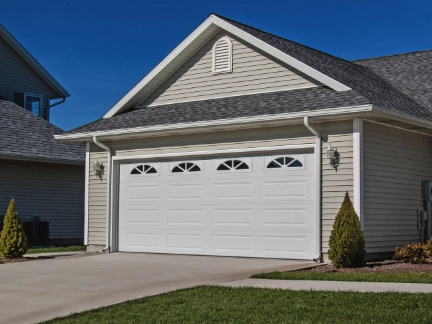
How a Garage Door System Works
A modern overhead garage door operates through a carefully balanced mechanical system. When you use an automatic opener with a remote, keypad, or app, a motor drives a trolley along a rail.
It pulls the door open along a set of tracks. The door itself is counterbalanced by springs, which do most of the heavy lifting by storing and releasing tension. Cables connect the spring system to the door, while rollers guide each panel section smoothly along the tracks.
Understanding this interplay is key to diagnosing problems. A door that feels heavy, moves unevenly, or makes unusual sounds is usually pointing to one specific component in this chain.
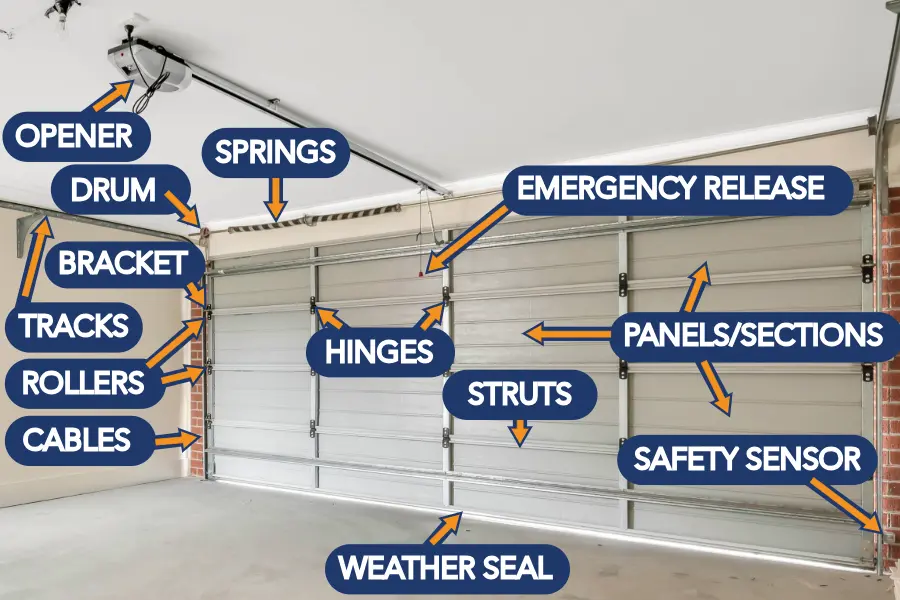
Main Garage Door Components
1. Garage Door Panels
Panels are the large rectangular sections that make up the visible face of the door. Most residential garage doors use between three and five horizontal panels connected by hinges, allowing the door to bend as it travels along the curved track from vertical to horizontal.
Panels are available in steel, aluminum, wood, fiberglass, and composite materials. Steel is the most common for its balance of durability and cost. Panels can be insulated or non-insulated — insulated panels improve thermal performance and reduce noise transmission from outside.
If one panel is dented or cracked, you can often replace just that panel. This depends on the model and if matching parts are available.
2. Tracks
Tracks are the metal channels mounted on either side of the door opening that guide the door as it moves. A standard residential setup includes vertical tracks (running up the sides of the opening) and horizontal tracks (extending into the garage ceiling). A curved section connects the two.
Tracks must be perfectly aligned and level. Even a slight bend or gap can cause the rollers to bind, making the door noisy or difficult to move. Tracks should be kept clean and free of debris, and checked periodically for alignment.
3. Rollers
Rollers are the small wheels that sit inside the tracks and allow the door panels to glide smoothly. They're attached to the sides of the door at each hinge point and at the bottom of the bottom panel.
Rollers are typically made of steel or nylon. Nylon rollers run quieter and don't require lubrication. Steel rollers are more durable under heavy use but benefit from regular oiling. Worn rollers — those that wobble, crack, or seize — are a common source of grinding or squealing noise and should be replaced as part of routine maintenance.
4. Springs (Torsion and Extension)
Springs are arguably the most critical component in the garage door parts list. They counterbalance the door's weight, making it possible for the opener motor (and a person) to lift a door that might weigh 150–400 pounds.
Torsion springs are mounted horizontally above the door opening on a metal shaft. They store energy by twisting when the door closes and release it when the door opens. Most modern systems use one or two torsion springs.
Extension springs run horizontally along the upper tracks on each side. They stretch and contract as the door moves. Extension spring systems require safety cables threaded through them to prevent injury if a spring breaks.
Spring failure is one of the most common garage door problems. A broken spring means the opener has to bear the full weight of the door — something it's not designed to do. Springs are under significant tension and can be dangerous to handle.
5. Cables and Cable Drums
Steel lift cables connect the bottom corners of the door to the spring system above. As the springs wind and unwind, the cables carry that force to raise and lower the door evenly on both sides. Cable drums, mounted at each end of the torsion spring shaft, spool the cables as the door moves.
Frayed, snapped, or improperly tensioned cables cause uneven movement and can lead to the door coming off its tracks. Cables should be inspected regularly for signs of wear. Replacement is a task best left to professionals, as cables work in conjunction with the spring tension system.
6. Hinges and Section Joints
Hinges connect adjacent panels to each other and allow the door to articulate — to bend as it transitions from vertical to horizontal. On a typical sectional door, you'll find hinges at every panel joint, usually three or four per seam.
Hinges are numbered by their position from the bottom up. Bottom hinges (Number 1) handle less stress, while top hinges handle more. They're typically made of galvanized steel and can wear out over time, especially if not lubricated. A broken hinge causes a panel to sag or bind, and is usually easy and inexpensive to replace.
7. Garage Door Opener System
The automatic opener is the motorized unit mounted to the ceiling of the garage, connected to the door via a drive rail and trolley. The motor drives a trolley along the rail, which connects to the door via a curved arm. Most residential openers use one of three drive types:
- Chain drive: Affordable and durable, but louder
- Belt drive: Quieter, better for attached garages
- Screw drive: Fewer moving parts, moderate noise level
Modern openers include built-in Wi-Fi, smartphone control, battery backup, and rolling code security technology. The opener is supported by a logic board, limit switches that control travel distance, and a capacitor or motor. Opener issues often involve the logic board, remote programming, or motor wear.
8. Safety Sensors and Emergency Release
All modern automatic openers are equipped with photo-eye safety sensors mounted near the floor on both sides of the door opening. They emit an invisible infrared beam. If anything breaks the beam while the door is closing, it reverses automatically.
The emergency release cord, often a red handle on the trolley, disconnects the door from the opener. It lets you open and close the door by hand. This is important during power outages or opener failures.
Sensor alignment is a frequent issue. If the sensors are bumped out of position, the door may refuse to close or reverse unexpectedly. Many opener systems indicate a sensor problem with a blinking light on the motor unit.
9. Brackets, Bearings, and Struts
Bottom brackets attach the lift cables to the bottom corners of the door. They're under significant tension and should never be adjusted without releasing spring tension first.
Bearing plates are mounted on the wall above the door on both sides and support the ends of the torsion spring shaft. Center bearings support the shaft in the middle.
Struts are horizontal steel reinforcement bars attached across the back of door panels. They prevent panels from flexing or bowing, especially on wider doors. The top panel almost always has a strut, and heavier or wider doors may have struts on additional panels. Struts are particularly important for doors with opener attachments.
10. Weather Seals and Insulation Strips
Weather seals keep out drafts, water, pests, and debris. The main types include:
- Bottom seal: A rubber or vinyl strip along the bottom edge of the door that compresses against the floor
- Side seals (stop molding): Foam or rubber strips running vertically along the door frame
- Top seal: Mounted along the top edge of the door opening
Seals wear out from constant compression, UV exposure, and temperature cycles. Replacing a worn bottom seal is one of the easiest DIY maintenance tasks and makes a noticeable difference in energy efficiency and pest prevention.
Insulation — typically polystyrene or polyurethane foam bonded to the inside of steel panels — helps regulate temperature and reduce noise. Insulated doors are measured by their R-value; higher R-values offer better thermal resistance.
Maintenance and Common Garage Door Issues
A well-maintained garage door system can last 15–30 years, but neglect shortens that lifespan significantly. A few simple habits go a long way. For a full breakdown of what to check and how often, see our garage door maintenance guide.
Basic maintenance tasks
- Lubrication: Apply a silicone-based or lithium grease spray to rollers, hinges, tracks, and the torsion spring (not the tracks themselves — lubricant on tracks attracts debris). Lubricate garage door parts once or twice a year.
- Hardware inspection: Check all bolts, lag screws, and mounting hardware for looseness. Vibration from regular use gradually works fasteners loose.
- Visual inspection: Look for frayed cables, cracked rollers, rusted springs, and damaged weather seals.
- Balance test: Disconnect the opener and manually lift the door halfway. It should stay in place. If it falls or rises, the spring tension needs adjustment.
Common issues to watch for
- Door not opening smoothly: Usually caused by worn rollers, misaligned tracks, or broken springs.
- Noisy operation: Grinding or squealing typically points to dry rollers or hinges. Banging or popping may indicate a worn opener drive or loose hardware.
- Uneven movement: One side moving faster or the door appearing tilted often means a broken cable or unevenly tensioned springs.
- Sensor misalignment: The door reverses or won't close; check that the sensor LEDs are lit and both units are pointed at each other.
General component lifespans
- Torsion springs: 10,000–20,000 cycles (roughly 7–14 years with typical use)
- Rollers: 10–15 years (nylon last longer than steel)
- Cables: 8–15 years
- Opener motor: 10–15 years
- Weather seals: 2–5 years
Garage Door Parts FAQs
What are the most important parts of a garage door system?
Springs and cables are the most mechanically critical components — they bear the door's weight and control its movement. Without functioning springs, the opener cannot safely operate the door. Safety sensors are equally important from a safety standpoint, as they prevent the door from closing on people, pets, or vehicles.
How long do garage door parts usually last?
It depends on usage frequency and maintenance. Torsion springs typically last 10,000–20,000 cycles.
Cables and rollers often reach 10–15 years with proper lubrication. Opener motors generally last 10–15 years. Weather seals wear out fastest, often needing replacement every few years.
What causes a garage door to become noisy or unbalanced?
Noise usually comes from dry or worn rollers and hinges, loose hardware, or a worn drive mechanism in the opener. Imbalance is typically caused by a broken or improperly tensioned spring, a snapped cable, or a bent track. Regular lubrication and hardware checks prevent most noise issues.
Can garage door springs be replaced safely by homeowners?
It's not recommended. Torsion springs are under extreme tension — enough to cause serious injury if mishandled.
Extension springs are slightly less dangerous but still risky without proper tools and technique. Most professionals advise against DIY spring replacement. If your spring has broken, contact a qualified technician.
Why are safety sensors important on modern garage doors?
Safety sensors prevent the door from closing on a person, child, pet, or object in the doorway. They've been required on all new automatic garage door openers in the U.S. since 1993. Without functioning sensors, a closing door becomes a significant hazard. Keeping sensors clean and properly aligned is a basic but essential maintenance task.
Conclusion
A garage door is one of the most mechanically active parts of any home, cycling thousands of times over its lifespan. Understanding garage door part names and what each part does helps you spot problems early. It also helps you talk clearly with technicians. You can make smarter choices about repair or replacement.
Whether you're dealing with a noisy opener, a worn spring, or seals that no longer keep the weather out, most issues trace back to a specific, identifiable component. Regular checks and lubrication will keep your system running well for years. But when the door reaches the end of its useful life, a full replacement is often best.
Ready to explore your options? Browse our residential garage doors to find the right fit for your home, style, and budget.


 866-4FELDCO